A sixth sense for safer cycling
A MODYN graduation project by Luc Jansen — exploring how vibration, not screens or sound, could help older cyclists feel danger before they see it.
Cycling is changing fast. Cycle paths are busier, the mix of vehicles is wider, and the speed differences between them keep growing. For most of us that means a more demanding ride. For older cyclists, it can mean something far more serious.
The numbers are sobering. In the Netherlands, cyclists account for a large share of road fatalities, and the great majority of those deaths involve people aged 60 and over. As e-bike use keeps rising within this group, the safety of older riders has become one of the most urgent design challenges in mobility today.
This is exactly the kind of question we love to sit with at MODYN. So when Luc Jansen came to us to carry out his master graduation project, we gave him a professional home, the right stakeholders, and the freedom to push a genuinely speculative idea:
What if a cyclist could feel danger before seeing it?
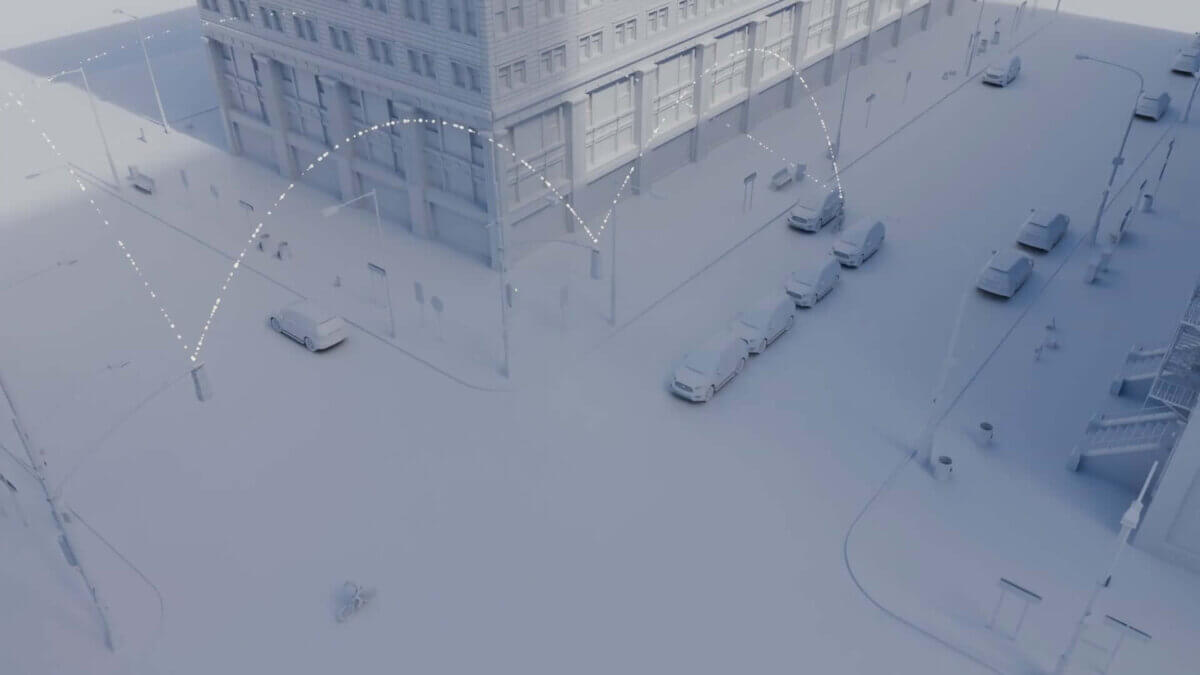
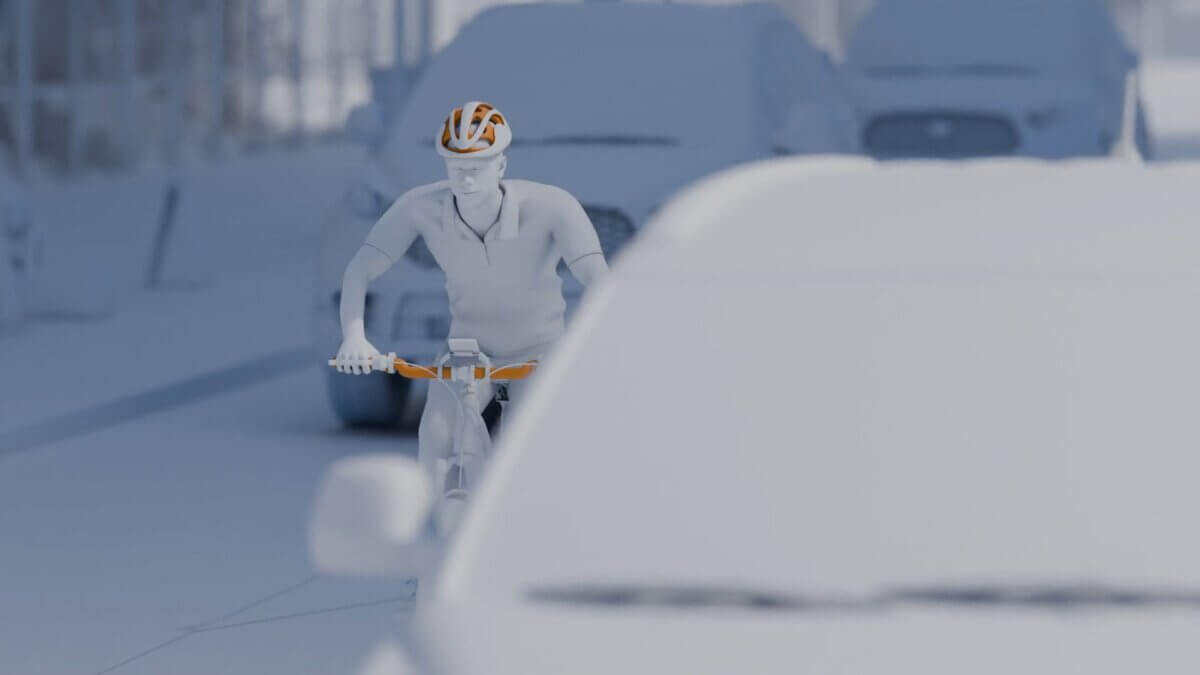
Much of the danger on the road happens in moments where road users simply can’t see each other in time — hidden behind a parked van, a building, a blind corner. These are known as Non-Line-of-Sight (NLOS) situations, and they’re behind a significant portion of serious cycling conflicts with motorised traffic.
Here’s the promising part: the technology to solve this is arriving. Vehicle-to-Everything communication — and its cycling cousin, Bike-to-Everything (B2X) — can make a cyclist digitally visible before they are physically visible. The car around the corner already “knows” the bike is there. The information exists.
But information that exists isn’t the same as information you can act on. Today’s warning systems lean almost entirely on two channels: your eyes and your ears. And those are precisely the channels a cyclist is already using to stay upright, hold a line, and read the road. Visual warnings ask you to look away. Audio warnings get drowned out by traffic and wind. For older riders — where processing can be slower and a shoulder-check costs real effort — this load is heavier still.
So the real challenge was never the connectivity. It was the interface.
Rather than add another screen or another beep, the project asked a different question: what if the warning bypassed the eyes and ears entirely, and spoke directly to the body?
That idea became the guiding vision — a kind of digital sixth sense. An additional sensory layer that stays quietly in the background and only speaks up when it matters, translating a hidden hazard into a spatial cue you simply feel. Not a disruptive alarm, but a calm, directional nudge: something is coming, and it’s coming from over there.
This reframed the whole brief. The goal was never to prove that connected technology works — that’s already happening across the industry. The goal was to prove it could be valuable: useful, usable, and genuinely supportive in the moment. In our language, the aim was a Minimum Lovable Product, not just a minimum viable one.
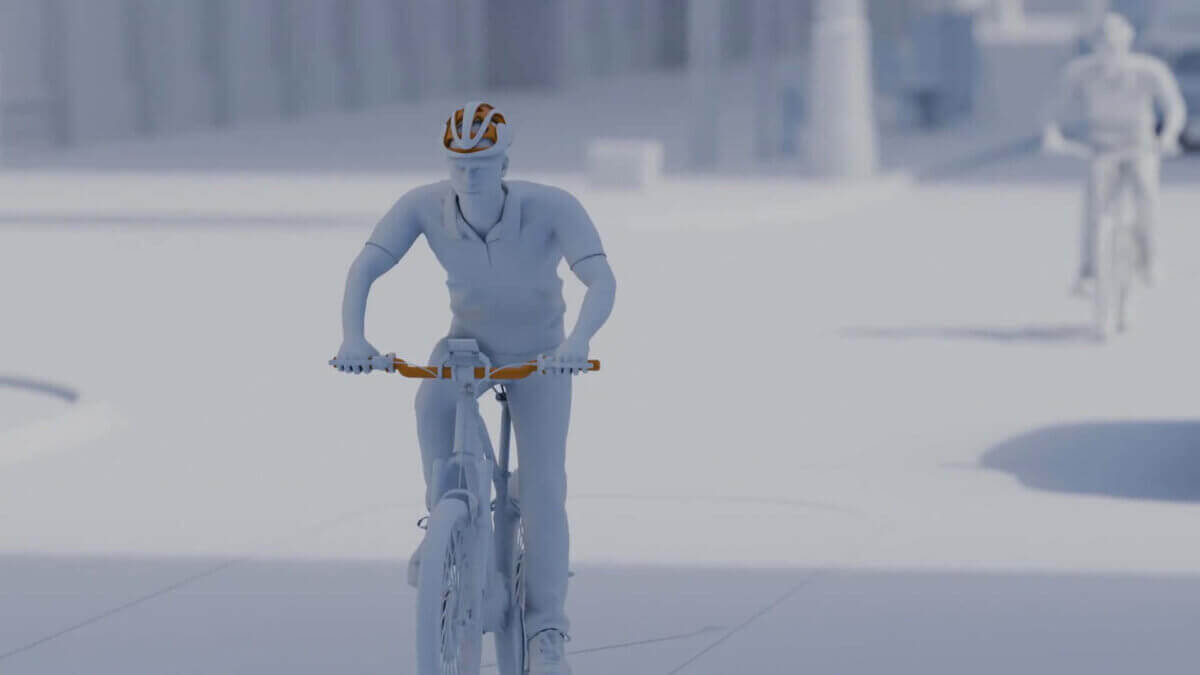
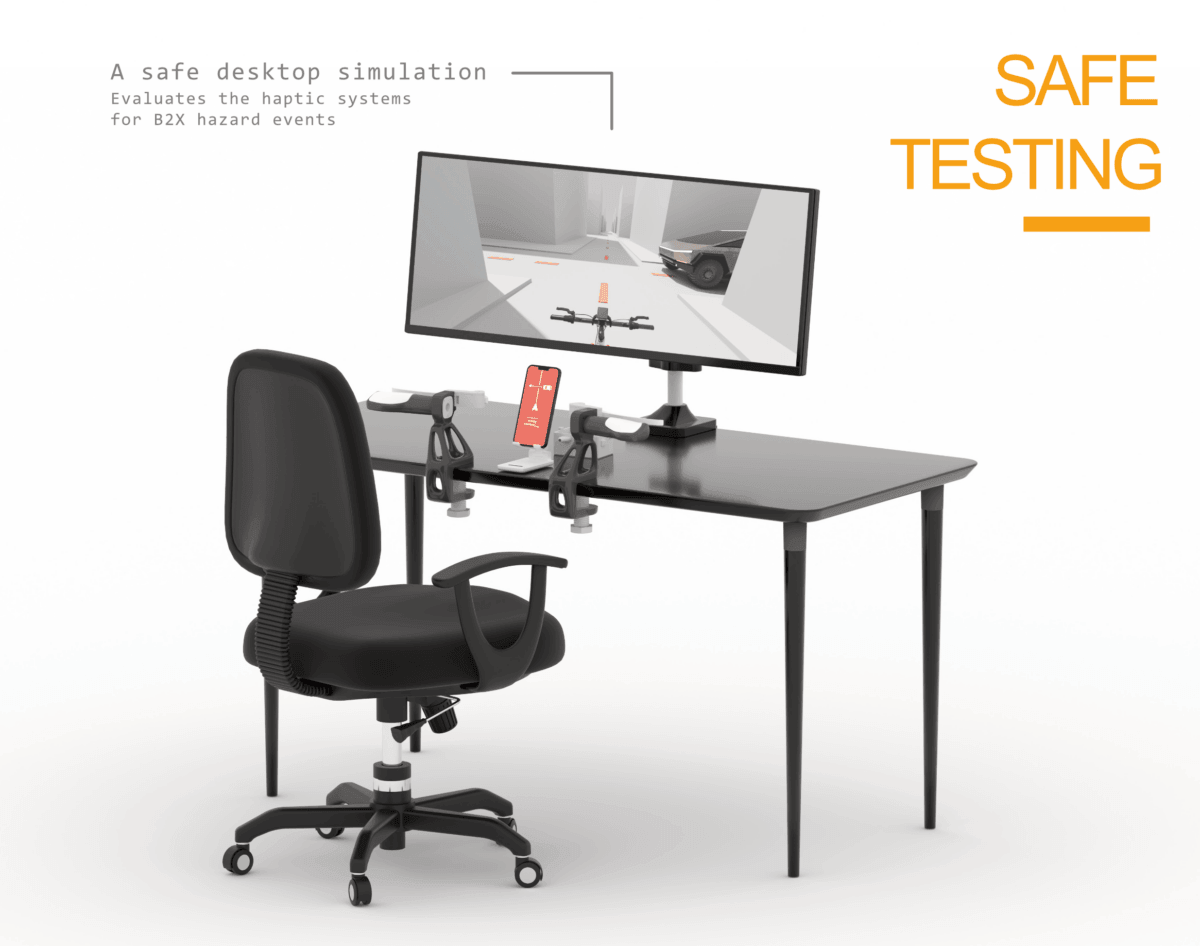
To test the idea in the real world, the project developed two ways of delivering a directional vibration — a research platform built to be ridden, not just demonstrated.
The first was a set of vibrating handlebars, signalling left or right through the rider’s hands. The second was a vibrating helmet, placing the cue closer to the rider’s natural sense of orientation. Crucially, both were tuned around early warnings — alerting the rider to where a hazard is with enough time to take it in calmly, rather than barking out a last-second instruction to swerve. Give people time, and they assess. Warn them too late, and you’re just reacting for them.
The prototype was then put in front of the people it’s designed for: older e-bike riders, in user testing largely hosted with our long-standing partner Gazelle.
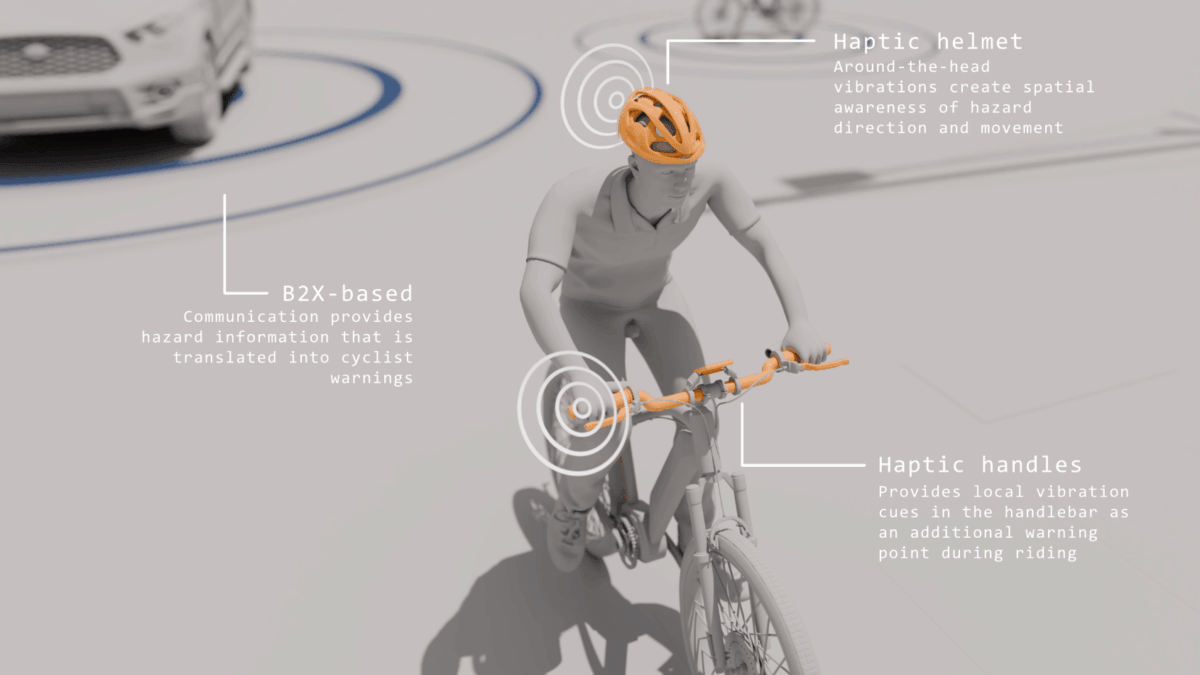
What makes this project stand out is that none of it was faked. The helmet and the handlebars are two fully independent, battery-powered modules, each with its own brain, sensors and haptic control — and they talk to each other wirelessly, with no router or pairing in between. A simulated hazard travels from the test environment to the handlebars, and on to the helmet, in a single connected chain.
Two engineering details are worth lingering on, because they’re where the real design intelligence lives.
The first is direction that stays true to the rider, not the bike. Each module carries a motion sensor. The handlebars know which way the bike is pointing; the helmet tracks where the rider’s head is turned. So when a warning fires, the helmet doesn’t just buzz “left” — it works out where the hazard is relative to where you’re actually looking, and places the vibration accordingly. Turn your head, and the cue moves with you. Getting this stable meant moving to a sensor with a built-in compass to stop the direction from quietly drifting over time — exactly the kind of unglamorous fix that separates a demo from something trustworthy.
The second is that the feel of a vibration is a physical design problem, not just an electronic one. The handlebars were 3D-printed and re-printed through many versions, because a stiff grip lets the buzz leak along the whole handlebar until you can no longer tell which side it came from. Softer materials, wall thickness, where the motor sits, even the print settings — all of it changes how local and how directional the signal feels in the hand. The body of the product turned out to be as important to the message as the electronics driving it. For a studio built on the marriage of design and engineering, that’s a lesson very close to home.
The results were genuinely encouraging — and refreshingly honest about where the work still lies.
Riders found the system easy on the mind. It didn’t overload them, and after trying it, they rated it as more useful than they’d expected beforehand. They felt more alert, better informed, and more aware of what was happening around them. The core promise — feel the danger, don’t read it — held up.
The standout finding was about where you place the signal. The helmet was dramatically clearer than the handlebars for telling riders which direction a hazard was coming from. When the cue sat near the head, people simply understood it faster and more reliably.
And then the most valuable insight of all — the kind only real testing surfaces. Some riders instinctively translated a warning on one side into braking on that same side. A signal meant purely to say “look here” was sometimes read as “act here.” It’s a subtle but critical distinction, and it points straight at the next iteration: a directional warning has to alert without ever being mistaken for an instruction.
The measured results back up the riders’ words. On a standard workload scale, the system landed low — a mean of 5.88 out of 20 — confirming it didn’t tax people mentally, even if the pace of some scenarios pushed them a little. On the acceptance side, perceived usefulness climbed from 1.15 before riding to 1.54 afterwards (on a −2 to +2 scale), meaning hands-on experience made people value it more, not less. Satisfaction stayed positive but flat at around 0.67 — they saw the promise, but comfort and signal intensity are clearly still on the to-do list.
The sharpest contrast came in directional clarity. Riders correctly read the helmet’s cues 87.8% of the time, with almost no missed signals. The handlebars managed 68.8%. In the trickiest scenario — a vehicle overtaking from behind — the gap widened dramatically: the helmet stayed clear while the handlebar version dropped to roughly a third correct. Same hazard, very different result, depending purely on where the signal met the body. That single comparison may be the most useful thing the whole project produced.
This project sits right at the heart of how MODYN thinks about the future of mobility. Connectivity is coming to the bike whether we design for it well or not. The opportunity — and the responsibility — is to make sure that future feels right in the hand, on the head, and in the moment. Safety technology only works when the human interface works.
A graduation project doesn’t deliver a finished product, and it isn’t meant to. What it delivers is a sharper question and a tested direction — and this one gave us both. The body, it turns out, may be one of the most under-used interfaces in cycling. Learning to design for it could make the next generation of e-bikes not just smarter, but genuinely safer for the people who need it most.
Our thanks to Luc Jansen for the curiosity and craft he brought to MODYN, to his supervisors Joost Alferink and Stefan Persaud, and to Maarten Pelgrim and the team at Gazelle for opening their doors, their bikes, and their riders.
Want to read more in depth? Check the complete master thesis here.
Curious how design direction can turn emerging technology into something people actually love to use? That’s the conversation we have every day. Let’s talk.